Jul 6, 2026

IT Support vs Managed IT Services

IT Support and Managed IT Services differ primarily in how they handle technology management. Traditional IT support follows a reactive approach, fixing hardware, software, and network issues after they occur, while managed IT services use proactive monitoring, maintenance, and security measures to prevent problems before they impact operations. For growing businesses, managed IT services provide stronger cybersecurity, predictable costs, reduced downtime, and strategic technology planning that supports long-term scalability and operational efficiency.
IT Support vs Managed IT Services

IT Support vs Managed IT Services: What Is the Real Operational Difference?

The modern corporate landscape requires robust technology ecosystems to survive. When building your digital setup, comparing IT Support vs Managed IT Services is a critical inflection point for technical execution. Many growing operations treat these distinct frameworks interchangeably, resulting in misallocated capital and unexpected downtime. The critical variance lies in operational execution: traditional tech help waits for structural failure, whereas managed workflows continually patch, monitor, and optimize your systems.

Choosing an inadequate strategy stalls your scaling efforts and exposes sensitive data to threat actors. For startups navigating high-growth phases, selecting a tech infrastructure model changes everything from day-to-day engineering to quarterly balance sheets. At Sentant, we architect resilient technology environments that safeguard critical infrastructure, optimize resource deployment, and scale smoothly with your organizational footprint.

Key Takeaways

  • Operational Alignment: Standard support resolves active hardware failures and software bugs after they interrupt workflows, while managed frameworks enforce proactive configuration.
  • Security Posture: Managed IT introduces continuous patch compliance, asset hardening, and proactive endpoint visibility rather than clean-up after a breach.
  • Resource Management: Subscription-based infrastructure management stabilizes monthly technology expenses and removes erratic billing from catastrophic breakdowns.
  • Business Transformation: Ongoing tech management bridges immediate operations with scalable infrastructure, ensuring technical debt does not choke development.

What Is Traditional IT Support and How Does It Address Breakages?

IT support refers to reactive technical assistance provided on demand when hardware, applications, or network infrastructure fail. This break-fix operational framework ensures that when specialized technical assets glitch, an available engineer diagnoses the anomaly to restore basic business utility. It acts as an emergency response asset for acute localized technical failures.

The reality on the ground is that this model positions technology as a cost center that only gets attention when operations stop. In a busy office, standard help desk workflows treat the underlying symptoms of a network failure rather than structural bugs. If your local office switch undergoes packet loss, a support technician restarts the device to close the ticket. They won't review the local network topology or investigate firmware exploits.

Typical reactive technical workflows include:

  • Resolving runtime errors in localized business applications.
  • Replacing physical enterprise storage components and failed workstations.
  • Resetting credentials across directory services.
  • Restoring access to dropped localized local networks.
  • Provisioning physical corporate peripherals and endpoint drivers.
  • Reconfiguring user account permissions on access control lists.

Relying exclusively on this workflow keeps businesses trapped in a cycle of incident response. This architecture functions for small teams with minimal computational footprints, but scaling environments quickly find it drops their efficiency.

What Are Managed IT Services and How Do They Prevent Failures?

Managed IT services offer continuous infrastructure administration, combining network monitoring, automated patch deployment, and strategic engineering. Rather than waiting for a critical system collapse, managed service groups embed remote management tools directly into your system architecture. This setup neutralizes anomalies before they cascade into widespread downtime.

This model changes how internal teams interact with technology assets. Instead of managing individual computing units, the system focuses on holistic network availability, data integrity, and compliance. Managed providers install specialized telemetry software across all servers, endpoints, and cloud layers. When a hard drive shows predictive sector failures, a replacement is dispatched before a system crash occurs.

Standard continuous management suites involve:

  • Real-time system telemetry and persistent network traffic audits.
  • Automated endpoint compliance management and firmware updates.
  • Centralized security operations center deployment and endpoint detection.
  • Enterprise cloud orchestration and database tuning.
  • Automated data redundancy and routine recovery testing.
  • Long-term technical engineering and infrastructure roadmap alignment.
  • Third-party technological platform integration and vendor oversight.
  • Regulatory audit readiness for frameworks like SOC 2 or HIPAA.

Continuous management transforms technology into a reliable framework for growth. By establishing complete baseline visibility, companies can focus on core product delivery without worrying about hidden system bugs.

IT Support vs Managed IT Services: What Is the Core Strategic Distinction?

The core difference between IT Support vs Managed IT Services lies in the operational timeline: support corrects historical system failures, while managed services mitigate future technical liabilities. Traditional tech assistance activates exclusively after an asset drops offline, whereas managed setups monitor resource utilization, storage thresholds, and security event logs around the clock.

Consider a standard database corruption event. Under a conventional technical support setup, engineers look into the issue after users report database errors, which directly causes extended downtime. A managed provider spots storage exhaustion or memory leaks hours earlier, using live metrics to spin up supplementary cloud blocks before data corruption happens.

Here is the part most providers won't tell you: break-fix models profit from your systems falling apart. The longer an issue takes to fix, the more billable hours they stack up. Managed services align financial interests with your business stability. Because they operate on a predictable flat rate, they are incentivized to engineer a flawless, secure network that never breaks down.

How Do Reactive Help Desks Compare to Proactive System Administration?

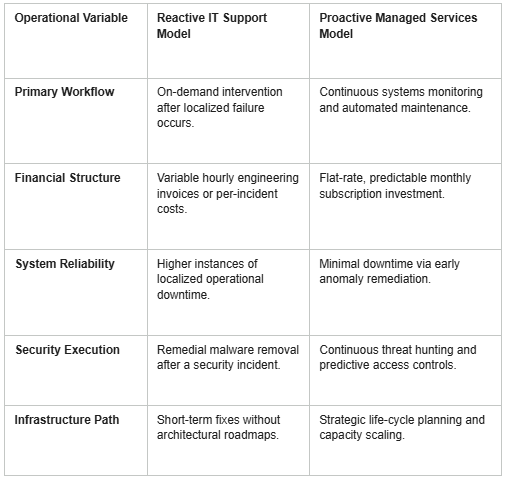
Evaluating technology strategies requires analyzing the trade-offs between reactive engineering and proactive infrastructure management. Both systems handle production issues differently, changing your overall business velocity.

The comparative breakdown below highlights how these two service models handle core operational needs:
Risk Mitigation

  • Break-Fix Vulnerability: Reactive engineering leaves your business vulnerable to unpatched software and configuration drift. When you only fix things after they break, critical security updates get missed.
  • Managed Resiliency: Proactive deployments eliminate human error through automated policy enforcement. Continuous compliance tracking ensures every laptop, server, and firewall matches strict baseline security standards.

Technical Execution

  • Ticket Backlogs: Standard support lines often leave teams stuck in deep queues during widespread outages. When a major bug hits, your employees waste productive hours waiting for an available technician.
  • Automated Remediation: Managed platforms deploy automated self-healing scripts right at the network edge. Many software conflicts and service drops are resolved by automated monitoring tools before a human ever needs to look at a ticket.

Which Framework Delivers Reliable Cyber Defense Against Modern Threats?

Managed service providers build stronger cybersecurity defenses by deploying ongoing threat hunting, cryptographic access management, and behavior-based endpoint visibility. Traditional support groups handle security reactively, often stepping in only to re-image hardware after ransomware has already locked down a local network file share.

Modern cyberattacks bypass standard, signature-based antivirus software with ease. Defending against these threats requires deep, continuous visibility across your entire digital environment. Managed frameworks install advanced monitoring solutions that track process behaviors in real time. If an unauthorized script attempts to encrypt local data or exfiltrate configuration files, the system isolates the target device immediately.

Enterprise-grade managed defense programs deploy:

  • Extended Detection and Response (XDR): Continuous endpoint tracking that monitors system memory and process executions to block zero-day exploits.
  • Automated Patch Remediation: Programmatic firmware and operating system validation to eliminate software vulnerabilities before hackers can abuse them.
  • Immutable Backup Topologies: Offsite, read-only data mirrors that protect your business records from manual deletion or encryption during a breach.
  • Identity and Access Management (IAM): Strict multi-factor rules and contextual access controls that stop attackers from using stolen credentials.
  • Network Security Auditing: Periodic external vulnerability scans to find open ports and misconfigured cloud assets before malicious actors do.
  • Security Literacy Training: Automated phishing simulations that teach your staff to recognize social engineering tricks before they open a malicious link.

Relying on simple, reactive help desk workflows leaves dangerous security blind spots open for months. Proactive systems design stops threats early, keeping your critical business data secure and out of the hands of attackers.

How Do Long-Term Operational Expenses Compare Across Both IT Structures?

The pricing model for basic IT support uses an unpredictable hourly billing structure, whereas managed infrastructure services run on a predictable, flat-rate monthly subscription. While break-fix workflows might seem like a way to save money when things are running smoothly, a single severe network failure or ransomware attack can quickly result in massive emergency engineering fees.

True technology expenses go far beyond the direct engineering invoices you receive. When analyzing total costs, you have to factor in employee downtime, missed service agreements, and lost customer trust during an outage. If a core cloud system goes down for an afternoon, the cost of lost employee productivity can easily surpass the price of a comprehensive monthly management plan.

Furthermore, a managed services framework eliminates hidden lifecycle expenses. Instead of dealing with sudden capital requests when a critical firewall or server fails, your provider tracks equipment lifecycles continuously. They design a predictable hardware replacement roadmap, giving you months of lead time to balance your budget before making critical hardware purchases.

How Does Standard System Administration Drive Corporate Scalability?

When an enterprise scales, its underlying technological infrastructure must expand symmetrically without creating massive friction.

Scaling Strategy

  • Automated User Provisioning: Managed setups deploy cloud-based configuration tools to set up new workstations automatically. When a new hire boots their laptop for the first time, the system installs all required corporate applications, security profiles, and access permissions right over the internet.
  • Architectural Engineering: Managed teams provide dedicated virtual CIO advisory support to make sure your technology path aligns with your corporate growth targets. This strategic oversight ensures you don't waste budget on outdated platforms or restrictive data architectures.
  • Cloud Infrastructure Optimization: Providers continually analyze your cloud utilization metrics to eliminate wasted spend on over-provisioned servers. They resize computing resources dynamically, giving your apps the power they need during heavy traffic while cutting costs during quiet hours.

Bold Engineering Terms That Govern Modern IT Environments

  • Endpoint Detection and Response (EDR): An integrated security platform that monitors endpoints in real time to spot and isolate malicious activity.
  • Configuration Drift: The gradual variation in system settings over time, which can create hidden software bugs and security holes if left unmanaged.
  • Identity Providers (IdP): A centralized system that creates, maintains, and manages digital identities, ensuring secure user authentication across all cloud services.
  • Zero-Trust Architecture: A security framework built on the principle of "never trust, always verify," requiring strict identity validation for every person and device trying to access the network.
  • Recovery Point Objective (RPO): The maximum age of files that must be recovered from backup storage for normal operations to resume after a system failure.
  • Mean Time to Resolution (MTTR): The average time it takes to completely fix a system or device failure from the moment the issue is first reported.
  • Security Information and Event Management (SIEM): A centralized data analytics engine that aggregates and parses system logs from across your network to spot complex threat patterns.

Homeowner-Focused Analogy: Structural Home Inspections vs Emergency Home Repairs

Think of reactive IT support like calling an emergency plumber at 3:00 a.m. because a main pipe burst and flooded your basement. You are paying premium emergency rates just to stop the immediate damage, and you still have to deal with costly property repairs afterward.

Managed IT services operate like a comprehensive home maintenance plan. Technicians inspect your plumbing lines regularly, install smart pressure sensors, and clear small blockages before they stress the joints. You pay a predictable fee to ensure your plumbing runs perfectly, preventing catastrophic leaks from disrupting your life and budget.

Optimizing Your Digital Infrastructure for Lasting Success

Navigating the complexities of modern business technology requires a clear, deliberate management strategy. While basic break-fix support works well for handling small, occasional issues, growing companies need the deep visibility and proactive protection that managed service models deliver. Choosing a continuous management framework helps you eliminate unexpected downtime, build stronger defenses against cyber threats, and focus your internal resources on hitting core business goals.

Your 3-Step Technological Transformation Plan

  1. Request an Architecture Audit: Book a deep-dive review of your current tech setup to find hidden security gaps, outdated hardware, and cloud cost leaks.
  2. Standardize Your Device Fleet: Set up centralized device management software across all corporate laptops and servers to automate security patching and software updates.
  3. Launch Continuous Threat Monitoring: Deploy advanced endpoint security tools to catch and block modern cyber threats before they disrupt your daily workflows.

Ready to stabilize your monthly tech costs and build a secure foundation for growth? Contact our engineering team today to build a proactive IT infrastructure plan tailored directly to your business goals. Connect with our San Francisco office at (415) 805-2405 to eliminate system downtime and strengthen your operational security.

Frequently Asked Questions

Q: What is the primary difference between IT support and managed IT services?

A: IT support operates on a reactive break-fix model, resolving system issues and hardware failures only after they interrupt production. Managed IT services use a proactive model, combining real-time system monitoring and automated patching to catch and fix technical anomalies before they cause costly downtime.

Q: Are managed IT services more expensive than traditional IT support over time?

A: Managed services require a steady, predictable monthly investment, whereas traditional support invoicing fluctuates wildly based on system failures. Over the long term, break-fix models often become much more expensive due to emergency engineering fees, lost employee productivity, and the severe financial impact of unmitigated system downtime.

Q: Can growing startups in San Francisco benefit from managed IT services?

A: Yes, scaling startups benefit significantly from managed frameworks by using automated device provisioning to onboard remote employees smoothly. This model gives growing teams access to enterprise-grade technical expertise and essential cybersecurity architecture without the massive overhead of hiring a full-time, internal IT department.

Q: Which model offers better protection against ransomware and data breaches?

A: Managed IT services deliver vastly superior cyber defense because they include proactive tools like behavioral endpoint detection, automated patching, and immutable backups. Traditional tech support typically handles security reactively, stepping in only after an infection has spread across your network.

Q: How do I determine if my company is ready to transition to managed services?

A: Your business is likely ready for a managed service model if your team is losing productive hours to recurring tech glitches or if you need to pass strict security audits like SOC 2. Transitioning makes sense when unpredictable IT support bills begin straining your operational budget, or when managing your device fleet takes too much focus away from your core products.

Will Pizzano, CISM is Founder of Sentant, a managed security and IT services provider that has helped dozens of companies achieve SOC 2 compliance. If you’re interested in help obtaining SOC 2 compliance, contact us.

blog

Latest Insights and Trends

Explore our latest blog posts for valuable insights.

IT Support vs Managed IT Services

IT Support and Managed IT Services differ primarily in how they handle technology management. Traditional IT support follows a reactive approach, fixing hardware, software, and network issues after they occur, while managed IT services use proactive monitoring, maintenance, and security measures to prevent problems before they impact operations. For growing businesses, managed IT services provide stronger cybersecurity, predictable costs, reduced downtime, and strategic technology planning that supports long-term scalability and operational efficiency.

Cybersecurity Checklist for Startups

A cybersecurity checklist for startups is essential because it helps protect sensitive data, intellectual property, and business operations from costly cyber threats while building trust with investors and customers. By implementing security controls early, startups can reduce compliance risks, strengthen their security posture, and avoid expensive disruptions that could slow growth or derail funding opportunities. Ultimately, strong cybersecurity is not just an IT function—it is a critical business strategy that supports long-term scalability and enterprise readiness.

Venture Capital Firms Need Managed IT Services

Venture capital firms need managed IT services to protect sensitive financial data, maintain uninterrupted deal flow, and defend against increasingly sophisticated cybersecurity threats such as wire fraud and business email compromise. Professional IT management provides continuous monitoring, secure cloud infrastructure, regulatory compliance support, and advanced security controls that help safeguard investor information while keeping critical systems operational during fast-moving transactions. By outsourcing technology management, VC firms can reduce operational risk, improve cybersecurity, and allow partners to focus on sourcing and closing investments rather than resolving technical issues.

How Startups Prevent Data Breaches

Startups prevent data breaches by implementing strong security measures such as multi-factor authentication (MFA), zero-trust access controls, automated vulnerability scanning, continuous software updates, and secure backup systems. They also reduce risk by enforcing role-based permissions, protecting credentials with password managers and hardware security keys, and training employees to recognize phishing and other cyber threats. By building security into their infrastructure from the beginning, startups can protect sensitive data, maintain customer trust, and avoid costly disruptions that can hinder growth.

How IT Support Helps Startups Grow

IT support helps startups grow by providing secure, reliable, and scalable technology that reduces downtime, improves productivity, and protects critical business data. Through proactive monitoring, cybersecurity, cloud infrastructure management, and disaster recovery planning, managed IT services allow founders and employees to focus on innovation and growth rather than technical issues. By partnering with an experienced provider like Sentant, startups can build a strong technology foundation that supports rapid scaling, controls costs, and prepares the business for future expansion.

How to Choose IT Support for Venture Capital Firms

Choosing the right IT support for a venture capital firm is essential for protecting sensitive financial data, maintaining regulatory compliance, and ensuring seamless deal execution. The best providers offer strong cybersecurity, cloud-based infrastructure, rapid response times, proactive monitoring, and expertise with financial technology platforms to minimize downtime and operational risk. A specialized partner like Sentant helps VC firms build secure, scalable technology environments that support growth, improve collaboration, and allow investment teams to focus on sourcing and closing deals.

Affordable Managed IT Support for Startups

Affordable managed IT support helps startups maintain secure, reliable, and scalable technology without the cost of building a full in-house IT department. By outsourcing IT management, startups gain access to proactive cybersecurity, cloud optimization, 24/7 monitoring, data backup, and expert technical support that reduce downtime and protect valuable business data. Providers like Sentant help founders streamline operations, control IT costs with predictable pricing, and build a strong technology foundation that supports growth, investor confidence, and long-term success.

Software Bill of Materials

A Software Bill of Materials (SBOM) is a structured inventory of all components, libraries, and dependencies within a software product, and it has become critical for startups seeking enterprise customers, compliance approval, and stronger cybersecurity posture. It helps organizations quickly identify vulnerabilities, manage open-source licensing risks, and demonstrate transparency during procurement and technical due diligence, while also supporting regulatory requirements like the EU Cyber Resilience Act and U.S. security mandates. By automating SBOM generation in CI/CD pipelines, startups can maintain continuous visibility into their software supply chain, build trust with buyers, and accelerate security reviews.
Why VC Firms Need Managed IT Services

Managed IT services help venture capital firms secure sensitive financial data, maintain reliable cloud infrastructure, and keep distributed deal teams operating without costly downtime. As cyber threats targeting financial firms continue to rise, outsourced IT support provides continuous monitoring, secure remote access, automated backups, and advanced protections against phishing, ransomware, and wire fraud. For modern VC firms, strong IT management is no longer optional—it is essential for protecting investor trust, meeting compliance demands, and maintaining fast-moving deal operations. By partnering with providers like [Sentant](https://sentant.net?utm_source=chatgpt.com), firms can streamline workflows, strengthen cybersecurity, and scale their infrastructure efficiently as assets under management grow.

Session Tokens

Modern cybersecurity threats have evolved beyond passwords and MFA, with attackers now targeting session tokens—the digital “all-access passes” stored in browsers after login. If hackers steal these tokens through malware, phishing, or malicious browser extensions, they can bypass MFA entirely and impersonate employees to access critical systems like Slack, AWS, or customer databases. For startups, this risk is especially dangerous because teams often use personal devices, maintain long session lifetimes, and grant broad admin privileges. To reduce exposure, companies should adopt identity-first security practices such as shorter session durations, device-bound authentication, hardware-backed passkeys, and continuous monitoring to detect suspicious activity before a breach escalates.

Best Cybersecurity Practices for Startups

Startups in 2026 face growing cyber threats, making strong security practices essential for protecting sensitive data, maintaining customer trust, and supporting business growth. Key cybersecurity strategies include using multi-factor authentication, Zero Trust security, endpoint detection tools, automated backups, employee security training, and continuous monitoring to reduce risks from phishing, ransomware, and human error. Sentant helps startups build scalable, security-first environments with managed protection, compliance support, and proactive threat monitoring designed for fast-growing companies.

Startup IT Infrastructure

A strong startup IT infrastructure is essential for scaling efficiently, protecting data, and avoiding costly downtime as a company grows. By using cloud-first systems, standardized hardware, proactive security measures, and automated workflows, startups can improve collaboration, strengthen cybersecurity, and support rapid expansion without technical bottlenecks. Investing in reliable IT infrastructure early helps reduce technical debt, protect intellectual property, and keep teams productive as the business scales.

Remote IT Support for VC Firms

Remote IT support for VC firms ensures secure, fast, and reliable access to critical systems and sensitive investment data while enabling teams to work efficiently from anywhere. It provides enterprise-level cybersecurity, cloud management, and compliance support without the cost of building a full in-house IT team. This helps firms reduce downtime, prevent data breaches, and maintain a competitive edge in high-speed deal environments.

zero-trust architecture

This guide explains why startups should move from traditional VPNs to Zero-Trust Architecture (ZTA) to improve security and scalability. Unlike VPNs that grant broad access once logged in, Zero-Trust continuously verifies users and devices, limits access with least-privilege rules, and prevents hackers from moving across systems if credentials are compromised. By adopting a phased transition to Zero-Trust, startups can enhance security, support remote teams, simplify compliance, and maintain productivity without the limitations of outdated VPN setups.

AI Data Security

AI data security is essential for startups because modern AI systems handle dynamic data, models, and user interactions that can easily expose sensitive information if not properly protected. Key practices include minimizing and sanitizing data before training, encrypting model weights, securing RAG pipelines, and using guardrails like prompt filtering and output monitoring to prevent leaks or attacks. By building security into the AI lifecycle early, startups can protect intellectual property, meet compliance requirements, and gain the trust needed to scale and win enterprise clients.

Cybersecurity Services for Healthcare in Los Angeles

Cybersecurity services for healthcare in Los Angeles are essential to protect sensitive patient data, maintain operations, and meet strict regulations like HIPAA. Medical organizations face constant threats such as ransomware and phishing, requiring advanced solutions like 24/7 monitoring, encryption, multi-factor authentication, and secure backups. By using managed security services, providers can reduce risk, ensure compliance, and focus on patient care while experts handle ongoing protection and threat response.

Austin TX Cybersecurity Company

A local Austin, TX cybersecurity company provides proactive, multi-layered protection—like 24/7 monitoring, threat hunting, and compliance support—to defend businesses from rapidly evolving cyber threats. Their on-site presence, fast incident response, and understanding of local regulations make them far more effective than generic providers. By partnering with a specialized local firm, businesses can reduce risk, maintain uptime, and build a secure foundation that scales with growth.

Cybersecurity Companies Los Angeles

Cybersecurity companies in Los Angeles provide essential protection against evolving threats like ransomware and phishing by offering proactive, 24/7 monitoring, encryption, and compliance support. Costs vary based on business size and complexity, but managed services offer scalable, predictable pricing that’s far lower than the cost of a breach. Choosing a local, experienced provider ensures faster response times, tailored solutions, and stronger long-term security for your business.

What to Know About IT Services for Venture Capital Firms

IT services for venture capital firms focus on building secure, scalable, and always-on infrastructure to protect sensitive data and keep deal flow moving without disruption. By adopting zero-trust security, compliance-ready cloud systems, and robust disaster recovery, firms reduce risk while enabling fast, seamless collaboration. A proactive, managed IT approach ensures operational resilience, minimizes downtime, and turns technology into a competitive advantage rather than a liability.

Managed IT Provider for Your Startup

Choosing a managed IT provider for your startup means finding a strategic partner that ensures security, scalability, and fast support while you focus on growth. Startups should assess their needs, prioritize providers with strong cybersecurity (like MFA and compliance readiness), and ensure they can scale بسرعة with hiring and operations. The right provider reduces downtime, prevents costly tech issues, and supports long-term growth with proactive, startup-focused solutions.

Why Cybersecurity Is Important for Startups

Learn why cybersecurity is important for startups. Protect data, prevent breaches, and secure your business from costly cyber threats.

Managed IT Services for Venture Capital

Managed IT services for venture capital firms provide specialized, proactive technology support that safeguards sensitive investor data, ensures regulatory compliance, and maintains seamless operations during critical deal-making periods. By leveraging enterprise-grade cybersecurity, automated cloud workflows, and rapid employee onboarding, firms reduce risk, increase operational efficiency, and scale effortlessly without IT bottlenecks. Partnering with a dedicated provider like Sentant turns technology from a potential liability into a strategic advantage that protects both reputation and deal flow.

IT Support Strategies for Startups

Startups often lose valuable time and money when founders or employees handle IT issues themselves, especially as teams grow. Implementing scalable IT support—such as a centralized helpdesk, structured onboarding/offboarding, and essential cybersecurity tools like MFA and password managers—helps maintain productivity, security, and smooth operations. Many startups benefit from managed IT services, which provide proactive monitoring and predictable monthly costs instead of reactive, expensive “break-fix” repairs.

Cybersecurity: What Startups Should Know

Cybersecurity is critical for startups because they are common targets for cybercriminals due to valuable data and often weak security defenses. A single breach can cause severe financial losses, legal issues, and reputational damage that many startups cannot recover from. To reduce risks, startups should adopt proactive security practices such as two-factor authentication, encryption, regular backups, employee training, and a clear incident response plan.

Importance of Managed IT Services for Startups

Managed IT services are essential for startups because they provide a secure, scalable technology foundation without the high cost of building an in-house IT team. By outsourcing IT management, startups gain predictable costs, stronger cybersecurity, and access to expert support while avoiding technical debt and infrastructure issues during rapid growth. This allows founders to focus on product development and scaling the business while reliable systems and proactive monitoring keep operations running smoothly.

IT Support for Small Business Startups

his guide explains why IT support for small business startups is a strategic growth driver, not just a break-fix utility. A strong, security-first IT foundation—built on cloud scalability, zero-trust security, and automated onboarding—prevents technical debt, reduces risk, and keeps teams productive as they scale. By using managed IT services instead of DIY setups or early in-house hires, startups gain enterprise-level expertise, stronger cybersecurity, and the freedom to focus on building products and growing the business.

Why Startups Need CyberSecurity

Cybersecurity is a strategic necessity for startups because early-stage companies often hold valuable intellectual property and customer data while operating with limited defenses. A single breach can trigger financial losses, operational shutdowns, and irreversible reputational damage that many startups cannot survive. By adopting basic security practices early—such as multi-factor authentication, least-privilege access, employee training, and incident response planning—startups turn security into a competitive advantage that protects growth, builds trust, and strengthens investor confidence.

Why Startups Are Turning to Managed IT Services

Startups are turning to managed IT services because they offer expert support, strong security, and scalable infrastructure at a predictable monthly cost. This model eliminates the expense of in-house IT teams while allowing startups to quickly add users, tools, and locations without disruption. By outsourcing IT to providers like Sentant, founders reduce risk, improve cybersecurity, and stay focused on growth, product development, and customers rather than daily technical issues.

Best IT Support Company for Startups

The best IT support company for startups provides scalable services, fast response times, clear pricing, and strong cybersecurity to reduce downtime and support rapid growth. Outsourced IT support helps startups avoid the high cost of in-house teams while ensuring reliable systems, secure cloud access, and proactive maintenance. Sentant stands out by offering startup-focused, flexible IT solutions that grow with the business and allow founders to focus on strategy instead of technical issues.

Tips and Best Practices about Cybersecurity for Startups

Cybersecurity is critical for startups because rapid growth and limited resources make them attractive targets for cyberattacks that can damage data, operations, and trust. This guide outlines practical best practices—such as securing the attack surface, using least-privilege access, monitoring threats, encrypting and backing up data, and training employees—to reduce risk without overspending. By making smart, scalable security investments early, startups can protect their assets, meet compliance needs, and grow with confidence.

Beginner's Guide To Managed IT Services For Startups

Managed IT Services give startups and growing businesses affordable, expert IT support without the cost of building an in-house team. By outsourcing tasks like network monitoring, cybersecurity, cloud management, and data backup, companies reduce downtime, improve security, and keep IT costs predictable. Working with a scalable provider like Sentant allows startups to focus on growth and innovation while ensuring their technology stays secure, reliable, and ready to expand.

How to Choose IT Support for Startups

This guide explains how startups can choose the right IT support by first assessing their current and future technology needs, then matching them with scalable services like managed IT, cloud solutions, cybersecurity, and help desk support. It outlines key selection criteria such as startup experience, service breadth, responsiveness, pricing models, security, and compliance. Overall, the content emphasizes that a proactive, flexible IT partner helps reduce risk, prevent downtime, and support sustainable growth as the business scales.

Cybersecurity Solutions for Startups

Affordable cybersecurity for startups focuses on using simple, low-cost tools—like password managers, two-factor authentication, and cloud security—to block the most common threats. Training employees, keeping systems patched, and backing up data regularly help prevent downtime and protect sensitive information. By starting small and building smart habits, startups can safeguard their business without needing large budgets or full-time IT teams.

Startup IT Issues

This guide explains the top startup IT issues—from cybersecurity and backups to scalability, hardware, and budgeting—and offers practical fixes to keep teams productive and secure. By planning early and using the right tools or managed services like Sentant, startups can avoid costly disruptions and focus on growth.

Costs of DIY IT in Startups

DIY IT often costs startups more than it seems by draining founder time, causing productivity-killing tech delays, and increasing the risk of outages or data breaches. Managed services replace unpredictable emergencies with a steady monthly cost, proactive monitoring, and stronger security, which boosts employee performance and supports smoother scaling. The piece positions Sentant as a partner that takes day-to-day IT off your plate so you can focus on growth and revenue.

Cyber Threats Targeting Startups

Startups face major cyber risks like phishing, ransomware, insider threats, weak access controls, and cloud misconfigurations, which can quickly disrupt growth and damage trust. The content emphasizes proactive defenses—employee training, strong identity controls, backups, monitoring, and secure cloud setup—to stop attacks before they cause harm. Sentant positions itself as a startup-focused partner offering managed tools, security expertise, and vCISO leadership to help companies scale safely without building an in-house security team.

Sentant IT and Security Alignment

Aligning IT and security breaks down silos, embeds protection into every technology decision, and helps organizations reduce risk while moving faster and more efficiently. When both teams share goals, governance, and processes, cybersecurity shifts from a reactive cost center to a business enabler that supports innovation, uptime, and compliance. Sentant emphasizes practical alignment through integrated tools, shared metrics, and a security-first culture that creates a safer, smarter digital environment.

What Is Required for SOC 2 Compliance

SOC 2 compliance means scoping the systems and processes that handle customer data, implementing controls aligned to the AICPA Trust Services Criteria (Security is mandatory, others optional), and consistently collecting evidence that those controls work in practice. Type I checks control design at a point in time, while Type II verifies they operate effectively over months, which most enterprise buyers prefer. Sentant positions itself as helping teams right-size scope, implement controls, and stay audit-ready without chaos.

The Beginner's Guide to IT Managed Services for Start ups

Managed IT services help startups outsource tech needs for a predictable monthly cost, getting 24/7 support, proactive monitoring, and stronger cybersecurity without building a full in-house team. This brings lower costs, faster issue resolution, and scalable IT systems, typically covering network and cloud management, backups, disaster recovery, and automatic updates plus expert guidance. Overall, an MSP lets founders stay focused on growing the business, with providers like Sentant highlighting startup-friendly, scalable support and strategic IT planning.

How Do You Handle Cybersecurity for a Startup

Startups can’t afford to neglect cybersecurity—one breach can devastate finances, reputation, and investor confidence. By establishing early security measures such as access control, encryption, employee training, and response plans, startups can protect data while staying agile. Sentant helps startups design scalable, cost-effective cybersecurity strategies that safeguard growth, ensure compliance, and prevent costly incidents.

What are SOC 2 Compliance Requirements

SOC 2 compliance is a security framework that verifies a company’s ability to protect customer data through five Trust Services Criteria: security, availability, confidentiality, processing integrity, and privacy. It requires independent audits to assess an organization’s controls, with Type 1 evaluating them at a single point and Type 2 measuring their effectiveness over time. Sentant simplifies this process through automation—streamlining evidence collection, integrations, and audits to help businesses achieve compliance faster and strengthen trust with customers.

What Is a vCISO

A vCISO (Virtual Chief Information Security Officer) is a part-time or on-demand security expert who helps startups build and manage their cybersecurity strategies without the high cost of a full-time CISO. They strengthen data protection, ensure compliance, and build investor and customer trust while aligning security with business growth. For startups handling sensitive data or seeking funding, a vCISO provides scalable, expert guidance that enables safe and confident expansion.

Essential IT Services for Small Business

IT services are vital for small businesses to stay productive, secure, and cost-efficient without needing an in-house IT team. Managed service providers offer proactive maintenance, remote support, and strong cybersecurity to prevent downtime and data breaches. Outsourcing IT enables small businesses to scale affordably while leveraging advanced technology and expert support.

IT Companies in Southern California

Sentant is a top IT company in Southern California that provides cybersecurity-first managed IT, cloud, and compliance solutions. They stand out for their fast, transparent, and locally informed support that prioritizes prevention, protection, and partnership. With scalable, tailored services, Sentant helps businesses across industries stay secure, compliant, and efficient while enabling growth.

Sentant Combine IT, Security, and Compliance for Startups

Denver’s growing tech scene has led to rising cyber risks, making it crucial for businesses to partner with a trusted cybersecurity provider. Sentant stands out by offering proactive monitoring, tailored solutions, compliance support, and 24/7 protection, all while leveraging local knowledge of Colorado’s regulatory environment. With decades of expertise and a reputation for reliability, Sentant provides long-term strategies that scale with businesses, positioning itself as a trusted cybersecurity partner for startups, mid-sized firms, and enterprises in Denver.

Cyber Security Companies in Denver

Denver’s growing tech scene has led to rising cyber risks, making it crucial for businesses to partner with a trusted cybersecurity provider. Sentant stands out by offering proactive monitoring, tailored solutions, compliance support, and 24/7 protection, all while leveraging local knowledge of Colorado’s regulatory environment. With decades of expertise and a reputation for reliability, Sentant provides long-term strategies that scale with businesses, positioning itself as a trusted cybersecurity partner for startups, mid-sized firms, and enterprises in Denver.

vCISO Service

A vCISO (Virtual Chief Information Security Officer) service offers companies executive-level cybersecurity leadership at a fraction of the cost of hiring a full-time CISO, making it especially valuable for startups and mid-sized businesses. While large enterprises or highly regulated industries may still require a dedicated in-house CISO, vCISOs provide scalable expertise, compliance guidance, risk management, and strategic oversight tailored to business needs. Ultimately, the choice depends on organizational size and complexity, but for many companies, a vCISO delivers equal or greater value by combining flexibility, breadth of knowledge, and cost efficiency.

SOC 2 Compliance for Startups

SOC 2 compliance is becoming essential for startups by 2025 as it builds customer trust, protects sensitive data, and demonstrates a company’s commitment to strong security practices. Achieving compliance requires rigorous preparation, including gap analysis, implementing security controls, gathering evidence, and working with accredited auditors, but it provides lasting benefits like resilience against cyber threats, easier scaling, and investor confidence. With expert guidance, such as from Sentant, startups can streamline the process and maintain continuous compliance to stay secure, competitive, and ready for growth.

Remote IT Support

Remote IT support helps startups stay productive by offering 24/7 availability, quick responses, proactive monitoring, and scalable low-cost solutions that eliminate the need for in-house IT teams. It strengthens cybersecurity with constant threat monitoring, regular updates, and employee training while also improving collaboration and remote work efficiency through optimized tools and integrated communication platforms. By outsourcing IT tasks, startups can focus on core business growth and innovation, gaining a competitive edge without being burdened by technical issues.

Managed IT Services

Managed IT services allow startups to scale faster by offloading IT tasks like device management, security, compliance, and onboarding to a specialized provider, freeing founders to focus on growth. They offer predictable costs, elastic capacity, and proactive monitoring to reduce outages while providing built-in security and compliance support from the start. This flexible model ensures smooth onboarding, standardized systems, and stronger resilience—helping startups stay productive and secure without building a full IT department too early.

Six Reasons Every SMB Needs A vCISO

A Virtual Chief Information Security Officer (vCISO) gives SMBs affordable, on-demand access to cybersecurity leadership and expertise without the high cost of hiring a full-time CISO. Unlike traditional CISOs, vCISOs provide flexible strategic guidance, regulatory compliance support, and access to specialist teams, helping businesses manage evolving cyber risks quickly and effectively. With benefits like lower costs, faster implementation, industry expertise, and alignment with security frameworks, vCISOs have become essential for SMBs seeking strong cybersecurity and compliance while focusing on core operations.

How to Prepare for a SOC 2 Audit

A SOC 2 audit evaluates how well a company safeguards customer data across five key areas—security, availability, processing integrity, confidentiality, and privacy—using real-world practices instead of a rigid checklist. Preparing involves narrowing the audit scope, running a gap analysis, updating policies, training staff, and conducting mock audits to avoid surprises and ensure smoother compliance. Being SOC 2 audit-ready builds trust with clients, speeds up business deals, and sets a foundation for future certifications like HIPAA or ISO 27001.

Proactive Cybersecurity Strategy for Your Organization

Cybersecurity is no longer optional, urging businesses of all sizes to adopt a proactive strategy instead of reacting after an incident. It provides a practical roadmap that includes identifying assets, addressing vulnerabilities, setting clear policies, training staff, and applying layered defenses guided by principles like zero trust and least privilege. Sentant supports organizations by simplifying policies, monitoring risks, ensuring compliance, and evolving strategies to strengthen security and client trust.

Outsourced IT Services

Outsourced IT services let growing companies access expert tech support without the cost or delays of hiring a full internal team. Sentant integrates directly into your workflow, providing 24/7 monitoring, cybersecurity, compliance readiness, and flexible scaling so your team can focus on growth. With fast, embedded support and transparent pricing, Sentant helps businesses run smoothly, innovate faster, and stay secure.

What Is SOC 2 Compliance and Why Does Your Business Need It?

SOC 2 Compliance is a crucial framework for businesses that handle customer data, especially in tech and cloud services, as it builds client trust and helps unlock larger deals. While not legally required, many clients demand it, making it a strategic necessity rather than a luxury. Sentant simplifies the complex compliance process by tailoring it to your business and supporting you every step of the way, ensuring you're not just compliant—but credible.

The Role of IT in Creating a Great Remote Work Culture

Remote work thrives on more than flexibility—it relies on a strong IT backbone. From secure infrastructure to seamless communication and tech support, IT ensures remote teams stay productive, connected, and protected. Sentant helps businesses build smarter, safer IT systems that make remote work smooth and stress-free.

Managed IT Services vs. In-House IT: Which Is Right for You?

Managed IT services offer cost savings, 24/7 support, and access to specialists, making them ideal for businesses looking to scale quickly without hiring a full tech team. In contrast, in-house IT teams provide more control, faster on-site response, and tailored solutions, but often come with higher costs and hiring challenges. Choosing between the two depends on your business size, goals, and technical needs—with some companies benefiting most from a hybrid approach.

5 Signs Your Business Needs a Professional IT Services Provider

If your business is experiencing recurring IT issues, unpredictable tech costs, or lacks strategic tech guidance, it may be time to bring in expert support. Sentant offers managed IT services tailored for fast-growing teams—covering helpdesk support, cybersecurity, compliance, and long-term planning. With flat-rate pricing and human-first service, they help small businesses stay secure, scale smoothly, and focus on growth without the tech headaches.

What Does SOC 2 Compliance Mean?

SOC 2 compliance is a cybersecurity framework that helps businesses—especially in tech and SaaS—demonstrate strong data protection practices through five Trust Service Principles: security, availability, processing integrity, confidentiality, and privacy. It boosts customer trust, strengthens internal security, and supports other regulatory standards like GDPR and HIPAA. By choosing between SOC 2 Type 1 and Type 2, companies can prove they not only have strong policies in place but also follow them consistently to safeguard sensitive information.

Qualities of Best IT Companies in California

When choosing an IT company in California, it's essential to find a provider that offers customized support, proactive solutions, and strong client relationships. Top IT firms prioritize transparency, continuous learning, and efficient service delivery while maintaining a strong reputation and community involvement. Sentant exemplifies these qualities, making it a standout choice for businesses seeking dependable and forward-thinking IT support.

What Is Cybersecurity as a Service

Cybersecurity-as-a-Service (CSaaS) is a cloud-based solution that allows businesses to outsource their cybersecurity needs to expert providers, offering around-the-clock protection without the cost of building an in-house security team. It includes essential components like network, data, and endpoint security, along with managed detection and response (MDR). CSaaS is a cost-effective, scalable alternative to traditional cybersecurity, especially for small and mid-sized businesses that lack the resources to maintain full-time security operations.

Top 10 Cybersecurity Threats Facing Small Businesses in 2025

The Hidden Costs of a Cyberattack And How to Prevent Them

Cyberattacks can cripple small businesses not just through immediate damage, but through long-term consequences like lost trust, reduced revenue, and increased costs. Hidden impacts—such as downtime, regulatory penalties, and team morale—often hit harder than the attack itself. Sentant helps prevent these outcomes with tailored, human-first cybersecurity solutions that protect without disrupting your day-to-day operations.

How Long Does It Take to Get SOC 2 Compliance?

Achieving SOC 2 compliance can take anywhere from 2 to 12+ months depending on your organization's security maturity and the type of report — Type 1 (faster) or Type 2 (more comprehensive). Type 1 typically takes 2–4 months, while Type 2, which requires a longer observation window, can take 6–12 months or more. With the right preparation, documentation, and expert support like Sentant’s, businesses can streamline the process and build trust with customers more efficiently.

Home WiFi Devices Roundup

In a perfectly connected world, the network should be fast, reliable and everywhere it’s needed. More now than ever, this means your home network needs some love and attention if it’s not up-to-snuff. Let’s look at the considerations that influence the way Sentant deploys networks in residences and at some of the best systems to deploy

5 Ways to Secure Zoom for Business

If you’re reading this, chances are you’ve been asked by a customer or business partner for your company to become SOC2-compliant. Along the way, you’ve probably heard about the differences between Type I and II, or wondered what Trust Principles you’ll need, and how much it’ll all cost. This article hopes to quickly answer all of those questions.

What’s the difference between SOC 2 Type I and II?

If you’re reading this, chances are you’ve been asked by a customer or business partner for your company to become SOC2-compliant. Along the way, you’ve probably heard about the differences between Type I and II, or wondered what Trust Principles you’ll need, and how much it’ll all cost. This article hopes to quickly answer all of those questions.